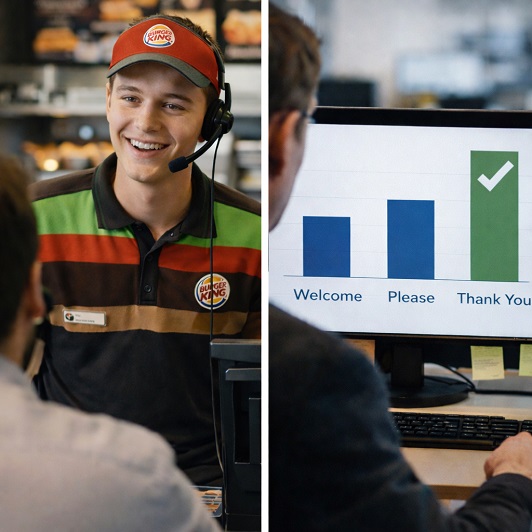
Featured Article : Burger King Deploys AI Headsets to Monitor Staff ‘Friendliness’
Publised on 03/03/2026 by
pandr_staff
Burger King is piloting OpenAI-powered headsets in 500 US restaurants that analyse drive-thru conversations, coach staff in real time and track hospitality signals such as whether employees say “please” and “thank you”.
What Is BK Assistant and How Does It Work?
The system, known as BK Assistant, sits inside employee headsets and a connected web and app platform. At its centre is a voice-enabled AI chatbot called “Patty”, built on OpenAI technology.
From the moment a customer pulls up at the drive-thru to the point they leave, the system analyses the interaction. It can prompt staff with recipe guidance, flag low stock levels such as a drink syrup running low, and alert managers if a customer reports an issue via a QR code.
It can also detect certain hospitality phrases. Burger King has confirmed that the system can identify words such as “welcome”, “please” and “thank you” as one signal among many to help managers understand service patterns.
Designed To Streamline Operations
Restaurant Brands International, the Miami-based parent company of Burger King, has described the platform as being “designed to streamline restaurant operations” and allow managers and teams to “focus more on guest service and team leadership”.
The company has, however, been very keen to stress that the tool is not intended to record conversations for disciplinary monitoring or score individual workers. In statements to multiple outlets, Burger King has said: “It’s not about scoring individuals or enforcing scripts. It’s about reinforcing great hospitality and giving managers helpful, real-time insights so they can recognise their teams more effectively.”
The pilot is currently running in 500 US restaurants. The wider BK Assistant platform is expected to be available to all US locations by the end of 2026.
Why Now?
Fast food is a high-volume, low-margin business where seconds matter. Drive-thru performance, order accuracy and customer satisfaction scores directly influence revenue.
AI promises to reduce friction. Recipe reminders reduce training time. Automatic menu updates prevent customers ordering out-of-stock items. Real-time alerts about stock levels and cleanliness issues allow managers to act faster.
There is also a broader industry push towards automation. Labour costs remain one of the largest operational expenses in quick-service restaurants. At the same time, recruitment and retention challenges have persisted in many markets.
Against that backdrop, using AI as a coaching and operational support tool seems to be a commercially logical decision.
The friendliness monitoring element, however, is what has triggered the strongest reaction.
Support Tool or Surveillance?
Online backlash has been swift. Some critics have described the system as dystopian, arguing that analysing staff speech risks creating a culture of constant monitoring.
Burger King has attempted to position the system as supportive rather than punitive. “We believe hospitality is fundamentally human,” the company has said. “The role of this technology is to support our teams so they can stay present with guests.”
From a management perspective, aggregated data on service patterns could be useful. From an employee perspective, the idea that an AI system is listening for key phrases raises legitimate concerns about trust and autonomy.
AI systems are not infallible. Speech recognition technology can struggle with regional accents, background noise or overlapping conversations, particularly in a busy drive-thru environment. A missed “thank you” or a misheard phrase could distort the data being fed back to managers, creating the risk of misleading signals. Over time, that kind of inaccuracy could erode confidence in the system, both for staff expected to trust it and for managers relying on it to guide decisions
There is also the wider debate about workplace surveillance. Customer service calls have long been recorded for quality purposes, but embedding AI analysis directly into frontline headsets seems to be a real step change in visibility.
So what is really going on? In reality, this is likely to be less about politeness policing and more about data. This is because fast food chains are increasingly treating operational behaviour as measurable input. Every interaction becomes a data point.
What It Means for Burger King and Its Competitors
For Burger King, the upside is operational consistency at scale. With thousands of restaurants, even marginal improvements in order accuracy or service speed can translate into significant revenue gains.
However, there’s also a reputational risk to coinsider here. If staff perceive the system as intrusive, morale could suffer. If customers view it as excessive monitoring, brand sentiment could be affected.
Competitors Doing IT Too
Burger King is not the only fast-food company using AI. Across the sector, major brands are investing heavily in artificial intelligence as they look for gains in speed, consistency and tighter operational control.
Yum Brands, the parent company of KFC, Taco Bell and Pizza Hut, has announced partnerships with Nvidia to develop AI technologies across its restaurant estate, signalling a broader move towards data-driven kitchens and smarter front-of-house systems. McDonald’s has also experimented in this space. It previously tested automated AI order-taking at drive-thrus through a partnership with IBM before ending that trial in 2024, and has since turned to Google as it refines its AI strategy.
Quick-service restaurants are evolving into technology-led businesses, embedding AI into ordering systems, kitchen workflows and customer interactions in pursuit of efficiency and consistency at scale.
What Does This Mean For Your Business?
For UK SMEs and mid-sized organisations, this story is not really about burgers at all. It is about artificial intelligence moving out of the back office and into direct, frontline interaction with customers and staff.
Burger King is using AI to gather real-time operational data, coach teams and encourage consistent service standards. That same principle is now appearing across retail, logistics, healthcare and hospitality, where AI tools are increasingly shaping how people work rather than just analysing what has already happened.
That raises important governance questions. How exactly is the data being collected? How is it interpreted, and by whom? What visibility do managers have, and how clearly is the purpose explained to employees? These are not abstract compliance issues. They influence culture, morale and trust.
Used well, AI can remove friction, improve accuracy and support performance in ways that genuinely help staff do their jobs better. Used poorly, particularly in customer-facing roles, it can feel like constant surveillance, even if that was never the original intention.
For business owners, the lesson is not to avoid AI, but to introduce it carefully. For example be transparent about what the system does and doesn’t do. Set boundaries and make sure the benefits are visible to staff as well as management.
Technology can analyse behaviour and surface patterns. The quality of service, however, still depends on people. That balance will define whether AI in the workplace feels empowering or intrusive.