Sustainability-in-Tech: Why Space Is Being Tested as a Home for Data Centres
Publised on 03/02/2026 by
pandr_staff
As the environmental and energy costs of Earth-based data centres rise sharply, companies are beginning to test whether space could offer a more sustainable and resilient place to store critical data.
Rising Pressure On Earth-Based Data Centres
The global data centre industry has faced increasing pressure in recent years as demand has accelerated, driven by the expansion of cloud computing, streaming services and artificial intelligence. Management consultancy McKinsey estimates that global data centre demand will grow by between 19 percent and 22 percent each year through to 2030, a pace that is already placing strain on electricity grids, water resources and planning systems in many countries.
Data centres are so important now because they underpin a wide range of essential digital services, from online banking and government platforms to AI model training. As facilities have grown larger and more concentrated, their physical and environmental impact has become more visible. New developments are often located close to urban areas with strong network connectivity and access to power, increasing pressure on local infrastructure and communities.
Energy, Water And Local Resistance
Traditional data centres place some serious sustained demands on electricity networks because servers and cooling systems must operate continuously to prevent overheating. This means that many facilities also rely heavily on water-based cooling, which has become increasingly problematic in regions experiencing drought or long-term water stress.
As a result, new data centre developments in parts of Europe and North America have faced growing opposition or delays, with local authorities and communities raising concerns over water consumption, grid capacity and land use. These pressures are now colliding with national climate targets, as governments attempt to reduce emissions at the same time as demand for digital infrastructure continues to grow faster than efficiency improvements.
Why Some Firms Are Looking Beyond Earth
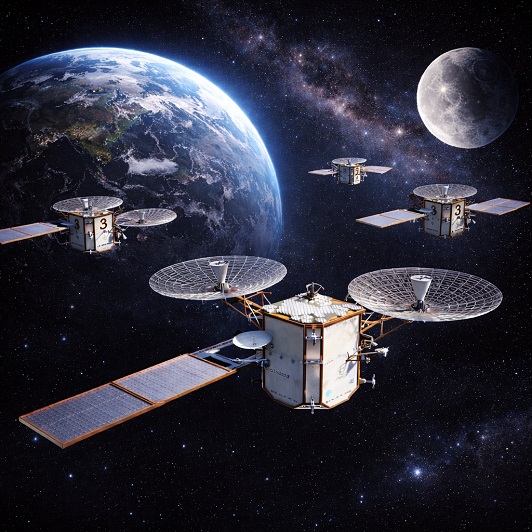
Against this backdrop, a small but growing group of companies operating at the intersection of space and digital infrastructure are exploring alternatives beyond Earth. The concept is not to replace terrestrial data centres, but to relocate certain types of data storage and processing to space, where resilience and long-term security are prioritised over ultra low latency.
Advances in launch technology, miniaturised electronics and solid state storage have made off planet infrastructure more technically feasible. Lower launch costs and more reliable space systems have enabled companies to begin testing whether space can support limited but valuable digital workloads.
Early Real World Experiments In Space
One of the most advanced efforts is being led by Lonestar Data Holdings, a Florida based company that has already tested a functioning data centre payload in cislunar space and is preparing for further missions around the Moon.
For example, back in February 2025, Lonestar launched its Freedom data centre payload aboard the Athena lunar lander operated by Intuitive Machines, with launch services provided by SpaceX. The payload travelled more than 300,000 kilometres and completed a series of commercial and technical tests designed to demonstrate that secure data storage and limited edge processing can operate reliably beyond Earth.
In a March 2025 press release, Lonestar confirmed that its payload successfully performed file uploads and downloads, encryption and decryption, authentication, and in space data manipulation for government and enterprise customers. The company also reported that power, temperature, CPU memory and telemetry readings remained stable throughout the mission, indicating that the system could operate within expected limits in the space environment.
Testing Sustainability Claims In Practice
Proponents of space based data centres argue that space offers physical characteristics that could reduce environmental impact compared with Earth-based facilities. For example, putting a data centre in space means that solar energy is constant and unobstructed, avoiding the intermittency associated with renewable generation on Earth. Also, heat can be dissipated through radiative cooling into the vacuum of space, thereby reducing the need for water intensive cooling systems.
Lonestar has highlighted these properties as central to its long-term plans. The company says it intends to operate around the Earth Moon L1 Lagrange point, a region of gravitational stability approximately 300,000 kilometres from Earth that allows continuous solar exposure and a relatively stable thermal environment.
In its public materials, Lonestar states that space provides “twenty four hour access to clean free solar energy and natural radiative cooling”, while also noting that physical distance can enhance resilience and security for specific categories of data.
Data Sovereignty Beyond Earth
Data sovereignty has emerged as another key factor driving interest in off planet storage. For example, governments and regulated sectors often require sensitive data to remain under defined legal jurisdictions, a requirement that can be complex in globally distributed cloud environments.
Lonestar argues that existing space law provides a framework for meeting these obligations. Under international treaties, space objects fall under the jurisdiction of the state that licenses or launches them, effectively extending national legal authority beyond Earth.
In its March 2025 announcement, the company said that “leveraging Earth’s largest satellite, the Moon, and the space around it to ensure secure data storage with data sovereignty, security, resiliency and redundancy will become increasingly vital”.
Chris Stott, Lonestar’s executive chair, described the successful in space tests as a foundational moment for the sector, stating, “This is our Kitty Hawk moment. This is where the future begins for this new resilient layer of critical global infrastructure serving us all down here on Earth.”
Independent Studies And Wider Industry Interest
Lonestar’s work actually reflects broader interest across the space and data infrastructure sectors. For example, a European Commission funded feasibility study known as Ascend, led by Thales Alenia Space, concluded in 2024 that orbiting data centres could offer environmental advantages over ground-based facilities under specific conditions.
The study suggested that a constellation delivering around 10 megawatts of computing power could be comparable to a medium sized terrestrial data centre, while avoiding land use and local water consumption. It also noted that the environmental case depends heavily on reducing emissions from launch systems across their full lifecycle.
Technical And Environmental Constraints
Despite growing interest, it must be said that some significant technical and environmental challenges remain. For example, launching hardware into space is still expensive and carbon intensive, even with reusable rockets. Also, once deployed, hardware is difficult or impossible to repair, and radiation exposure poses long-term reliability risks.
Cooling systems must be designed specifically for microgravity, limiting flexibility and upgrade options. Expanding space based data centres beyond niche, high value use cases would, therefore, require large numbers of launches and extensive orbital infrastructure, raising further questions around sustainability and space debris.
An Additional Layer Of Infrastructure
In reality, most proponents position space based data centres as a complementary layer rather than a replacement for terrestrial facilities. The strongest use cases involve disaster recovery, secure backups and long-term preservation of mission critical data, rather than latency sensitive workloads such as real time AI processing.
Lonestar has confirmed customers including the State of Florida and the Isle of Man government, both of which have highlighted resilience and independence from Earth-based risks as key factors. The company has also stated that capacity on its upcoming missions is already fully sold.
What has changed most significantly is that the concept has moved beyond theory. With functioning data storage already demonstrated in cislunar space, attention is now focused on scale, cost, environmental trade offs and how space based infrastructure may fit into wider sustainability strategies for a rapidly expanding digital economy.
What Does This Mean For Your Organisation?
It seems that space based data centres are now moving from conceptual discussion into early operational reality, but they remain a targeted response to specific pressures rather than a universal solution. The sustainability case rests on some clear trade offs. For example, space offers constant solar power, reduced water use and physical separation from climate and geopolitical risks, while also introducing new environmental costs through launches, manufacturing and long-term orbital operations. Whether the balance proves positive at scale will depend on continued reductions in launch emissions, careful limitation of use cases and a realistic assessment of where off planet infrastructure genuinely adds value.
For UK businesses, space based data storage is unlikely to replace domestic or regional data centres, but it may become relevant for organisations with strict resilience, disaster recovery or sovereignty requirements, particularly in regulated sectors such as finance, government and critical national infrastructure. For these users, space offers a potential additional layer of protection rather than a new primary platform, complementing existing cloud and on premises systems rather than displacing them.
For policymakers, regulators and infrastructure planners, the emergence of space based data centres highlights the growing tension between digital growth and environmental limits on Earth. It underlines the need to treat data infrastructure as critical national capacity, subject to the same long-term planning as energy, transport and water. Space is not a shortcut around sustainability challenges, but its growing role reflects how seriously those challenges are now being taken across the global digital economy.