Sustainability-in-Tech : The AI Data Centre That Could Change A Valley’s Climate
Publised on 02/06/2026 by
pandr_staff
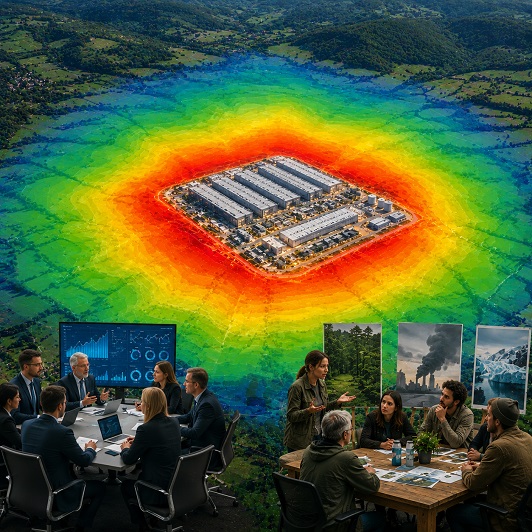
A proposed hyperscale AI data centre in Utah is drawing attention not only because of its size, but because researchers believe the heat it generates could have significant environmental consequences for the surrounding ecosystem.
What Is The Stratos Project?
The Stratos Project is a planned 40,000-acre energy and technology development in Utah’s Hansel Valley that would support large-scale AI computing, cloud services, and defence-related operations. Project backers say it could create thousands of jobs, strengthen energy resilience, and support national security priorities while generating substantial local revenue.
The development would include both a major data centre campus and dedicated on-site power generation designed to meet its energy needs without drawing power from the wider grid. According to the project itself, Stratos is intended to create “a secure, sustainable and resilient ecosystem” capable of supporting next-generation computing and critical national infrastructure.
Supporters argue this approach will minimise pressure on existing infrastructure while helping establish Utah as a centre for advanced computing and AI development.
Why Environmental Concerns Are Growing
The controversy centres on the sheer amount of energy involved.
For example, according to a preliminary thermal analysis by Utah State University physicist Dr Rob Davies, the completed project could require around 9GW of electricity for the data centre itself. When the associated natural gas power generation is included, the total thermal load could reach approximately 16GW, with all of that energy ultimately ending up as heat released into the local environment.
Davies describes the proposal as “a hyperscale level of thermal dump into this valley”, warning that the concentration of waste heat could create environmental effects extending far beyond the project boundaries.
His analysis estimates that the combined heat output would be equivalent to roughly 23 atomic bombs’ worth of energy being released into the local environment every day, not as an explosion, but as a continuous flow of waste heat.
The Valley Effect
One reason environmental scientists are paying close attention to the proposal is its location.
Hansel Valley is a high-desert basin where air circulation can become restricted, particularly at night when temperature inversions form and limit vertical movement of air. Davies’ analysis suggests this geography could trap heat within the valley rather than allowing it to disperse efficiently.
The preliminary modelling estimates daytime temperatures could rise by between 2°F and 5°F across parts of the valley, while night-time temperatures could increase by 8°F to 12°F. Although the figures remain subject to further study, the projections have raised concerns among environmental groups and local residents.
Potential Ecological Consequences
The concerns here extend beyond simple temperature increases. For example, desert ecosystems rely heavily on nightly cooling cycles that allow dew and frost to form. According to Davies, sustained increases in night-time temperatures could suppress these condensation cycles, reducing an important source of moisture for plants and wildlife. His report warns that “the ecological impact resulting from the combination of elevated temperatures and suppressed nighttime condensation is likely extreme”, while higher temperatures could also accelerate evaporation and increase drying across the region.
Campaigners have also questioned the potential impact on the wider Great Salt Lake watershed, an ecosystem already facing significant environmental pressures. The lake supports important wildlife habitats and migratory bird populations, making any additional environmental stress a sensitive issue.
The Other Side Of The Argument
Project supporters strongly dispute suggestions that the development will cause severe environmental harm.
Stratos argues that the project has been designed around “sustainable energy generation and water conservation technologies” and says advanced cooling systems will dramatically reduce water consumption compared with traditional data centre approaches.
Officials involved in the project also point out that the development remains subject to extensive environmental reviews, permitting processes, and regulatory oversight before construction can proceed.
Supporters further argue that much of the 40,000-acre project area will remain undeveloped and that the project could deliver thousands of jobs, major investment, and new infrastructure without placing additional demand on the state’s existing electricity grid.
Why This Matters Beyond Utah
The wider significance of the Stratos debate reaches far beyond a single project. As AI systems become larger and more powerful, the infrastructure needed to support them is expanding rapidly. Data centres already consume vast amounts of electricity, and future AI facilities are expected to demand even more energy, cooling capacity, and physical space.
The discussion surrounding Stratos highlights a growing sustainability challenge for the technology sector. While AI may help solve problems in healthcare, science, transport, and energy management, the infrastructure that powers those systems also carries environmental costs that are becoming increasingly difficult to ignore.
What Does This Mean For Your Organisation?
The Stratos Project illustrates a growing reality of the AI era, which is that digital technologies may appear weightless, but the infrastructure behind them is anything but. As governments and technology companies race to build larger AI facilities, questions about energy consumption, heat generation, water resources, emissions, and ecological impact are likely to become far more prominent.
Whether Stratos ultimately proves to be a model for sustainable AI infrastructure or a warning about the environmental consequences of hyperscale computing will depend on the outcome of future environmental assessments. What is already clear, however, is that sustainability discussions about AI are increasingly moving beyond software and algorithms and towards the physical footprint required to power the technology itself.
For organisations developing AI strategies, procuring cloud services, or pursuing sustainability targets, the debate serves as a reminder that the environmental impact of AI extends far beyond the applications employees see on their screens. As AI infrastructure grows, understanding the energy, resource, and environmental implications behind these technologies is likely to become an increasingly important part of responsible technology planning.